

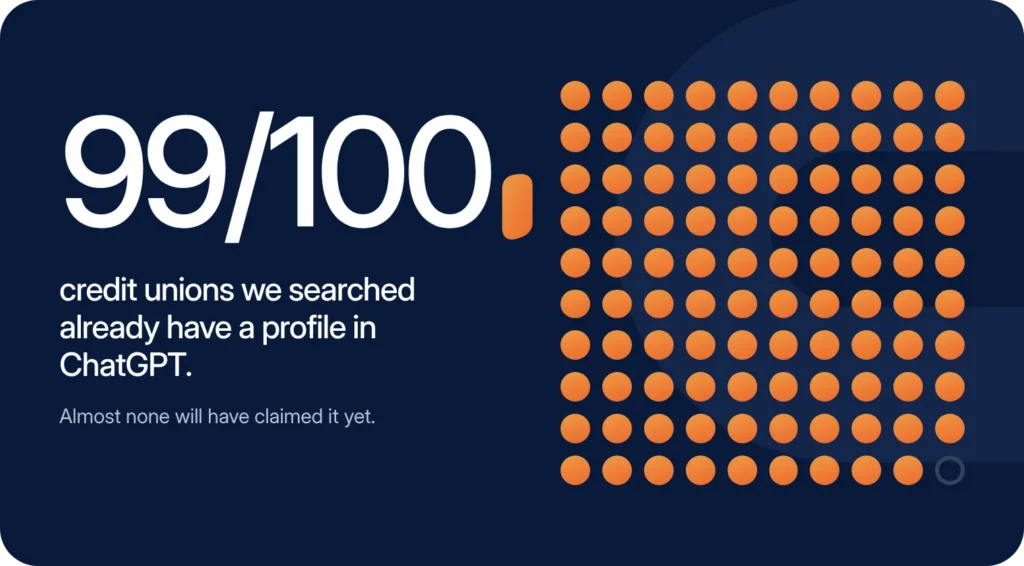
On Nov 10, OpenAI let businesses claim their profile inside ChatGPT. So we went looking for credit unions. We searched 100 of them, from a two-person shop to a $3B regional. 99 already had a profile. Almost none of them will have claimed it yet.
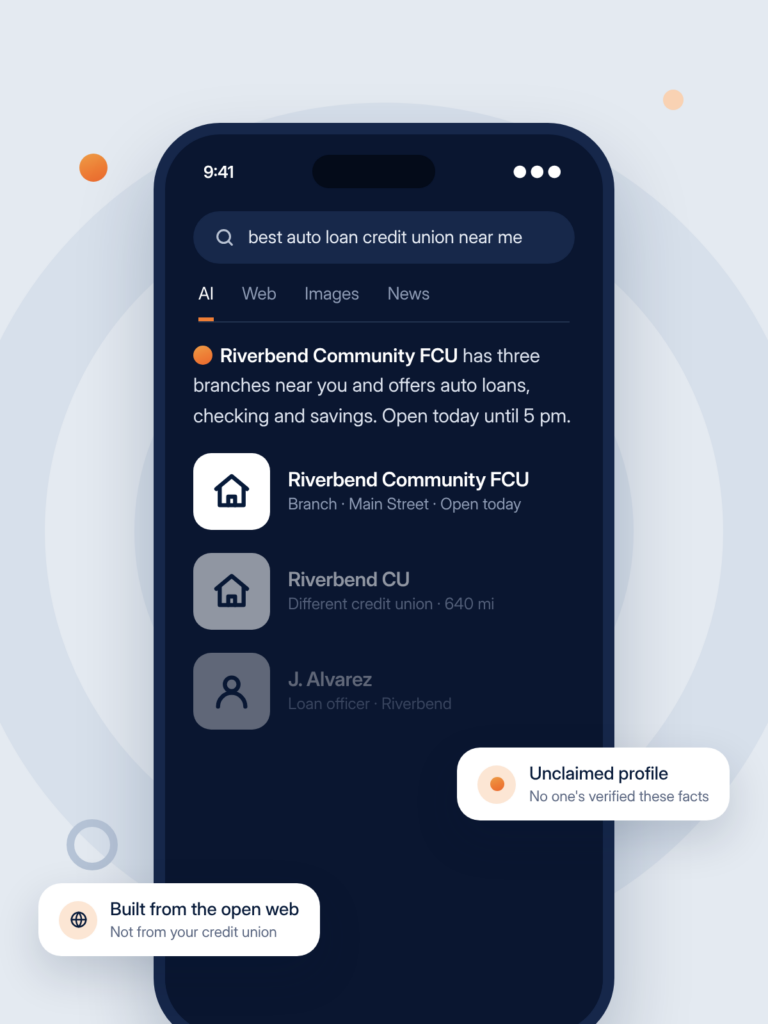
That means ChatGPT is already describing your credit union to members. The only question is whether you’re in charge of what it says.
What is Businesses in ChatGPT?
OpenAI launched Businesses in ChatGPT in beta, a direct line to the 1.2 billion people who use ChatGPT every week. Think of it as ChatGPT’s version of Google Business Profile.
1. Business Hub. Claim your profile, update your details, and see how often ChatGPT mentions you, how many clicks your website gets, and what people ask when you come up. Verified businesses get a blue checkmark.
2. Business Agents. A chatbot for your business inside ChatGPT. For now it’s limited to US ecommerce and online service businesses, so it’s not an option for credit unions yet.
Is your credit union already in ChatGPT?
We searched Business Hub for a random sample of 100 credit unions across four size bands, plus 20 of the largest in the country.
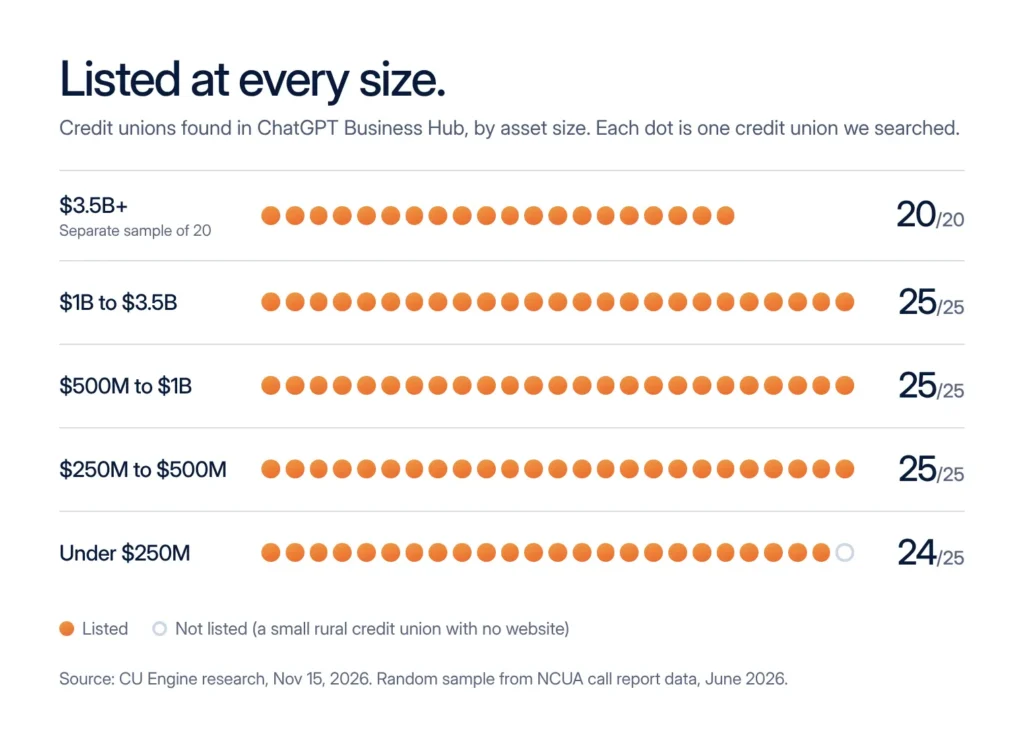
But being listed isn’t the same as being listed correctly. Here’s what we saw.
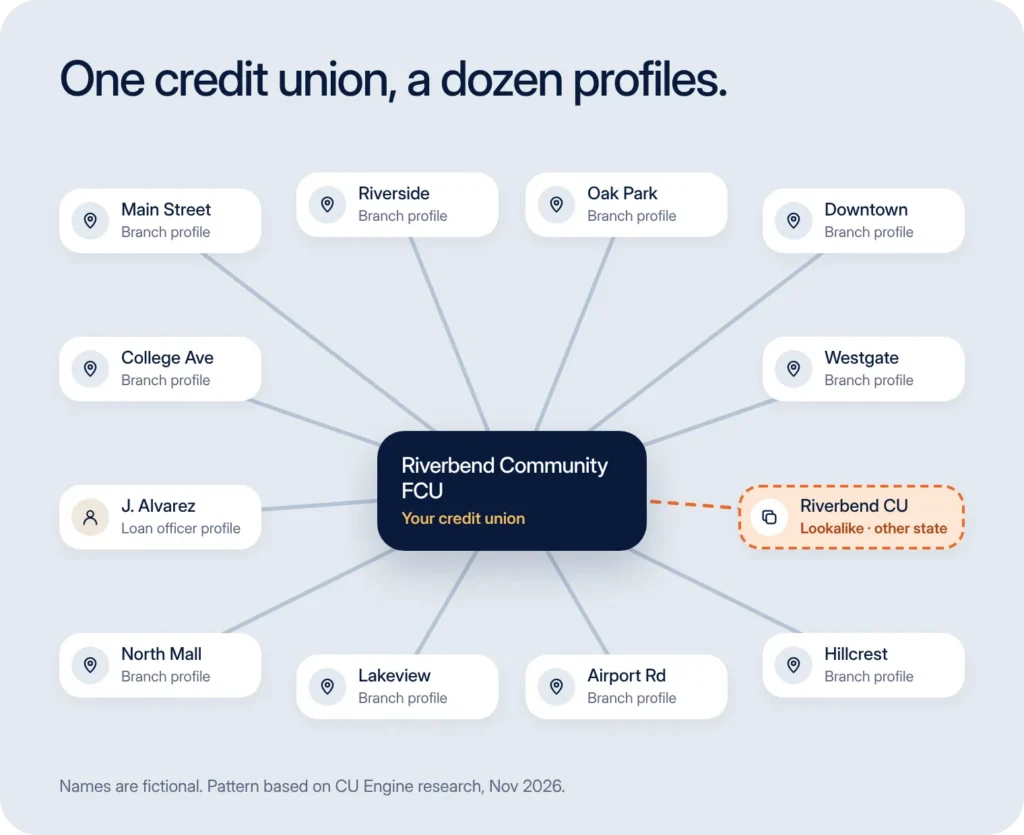
1. Every branch is its own profile. Searches returned up to 10 separate listings per credit union, one for each branch. Some even had individual loan officers listed. Each one is a separate set of facts ChatGPT can get wrong.
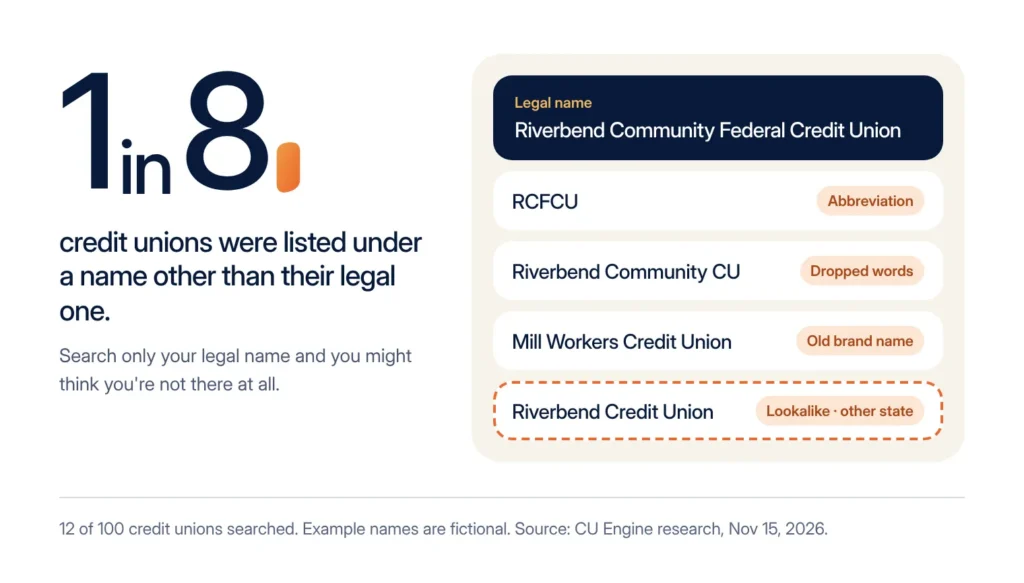
2. Names don’t match. About 1 in 8 credit unions were listed under a different name than their legal one: abbreviations, dropped letters, old brand names. If you search only your legal name, you might think you’re not there at all.
3. Lookalikes show up. Search for one credit union and you often get another with a similar name, sometimes in a different state. That’s a confused member waiting to happen, and an easy way to claim the wrong profile.
4. Nobody’s minding the store. The feature is days old. Right now, your profile is built from whatever ChatGPT found on the open web, not from you.
Why you must claim it now
Members are already asking. “Which credit union near me has the best auto loan rates?” is a real question, asked every day. ChatGPT answers it using these profiles.
Wrong facts arrive in ChatGPT’s voice. Old hours, a closed branch or the wrong name reach members as a confident answer. They won’t blame ChatGPT. They’ll blame you.
It’s the first real data on AI visibility. Once claimed, you can see mentions, clicks and the topics members ask about when you come up. That’s a content roadmap, straight from OpenAI.
The banks won’t wait. Megabanks and fintechs have teams watching this already. Credit unions that claim early get their facts straight while the channel is still quiet.
What our experts say
Venkata Pagadala, AI Search Researcher: “What surprised us wasn’t that credit unions were listed. It was how messy the listings are. One credit union can have ten branch profiles, a loan officer profile and a lookalike from another state, all competing to answer the same member question. ChatGPT pulls from those profiles, so every one that’s wrong is a wrong answer waiting to happen. Start by finding every version of your credit union, then fix the branches that drive the most loan and membership questions first.”
How can credit unions claim their ChatGPT profiles?
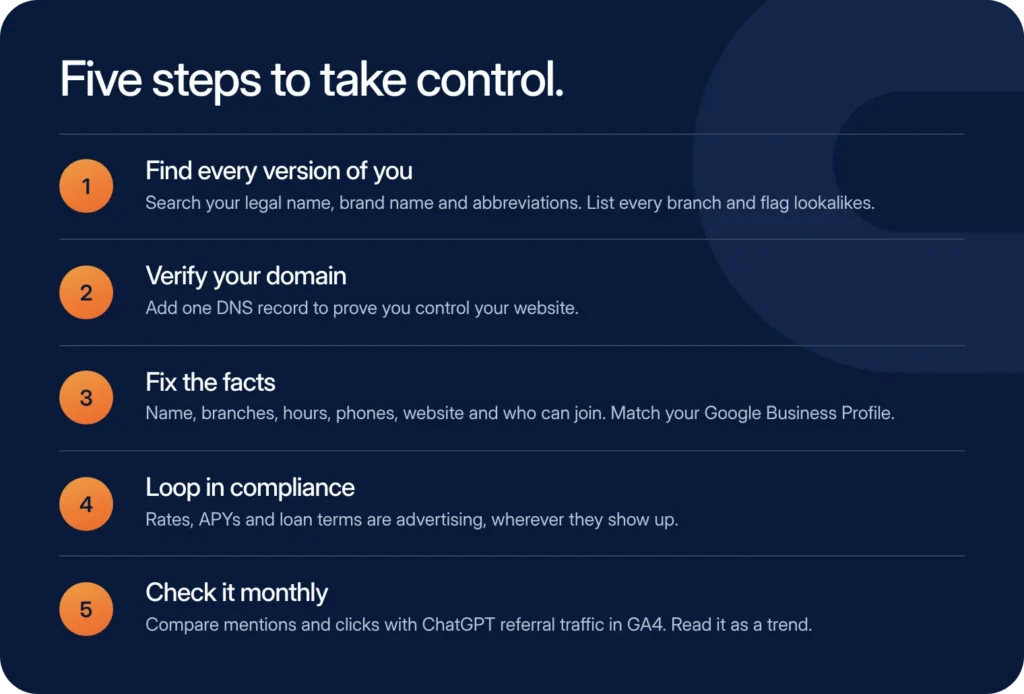
1. Find every version of you. Search Business Hub for your legal name, your brand name and any abbreviations. List every branch profile that comes up, and flag any lookalikes.
2. Verify your domain. Claiming means proving you control your website, with a quick DNS record your IT team or web host can add. It took us about 10 minutes.
3. Fix the facts. Name, branches, hours, phone numbers, website and who can join. Make them match your Google Business Profile and your website.
4. Loop in compliance (obviously). You know this one, but it’s worth saying: anything touching rates, APYs or loan terms is advertising, wherever it shows up.
5. Check it monthly. Compare mentions and clicks with ChatGPT referral traffic in GA4. OpenAI notes a click doesn’t confirm a site visit, so read it as a trend.
The bottom line
You don’t need to get your credit union into ChatGPT. It’s already there. What you need is to take control of what it says, before a member (or prospective member) gets the wrong answer.
Want help checking how your credit union appears in ChatGPT? Contact CU Engine about an AI visibility review.
Frequently Asked Questions
1. How can a credit union claim its ChatGPT profile?
An authorized representative should open Business Hub, search for the credit union and select the matching listing. Use an offered verification method, such as business phone, business email or website domain. Complete claim approval and the required Persona identity verification before publishing information changes or viewing insights.
2. Does claiming the main credit union profile also claim every branch?
No. Claiming the main brand does not automatically claim its location profiles. Search for the institution’s brand name, alternate names and branch locations, then confirm the name and address of each result. For locked locations or managed claims, follow OpenAI’s supported process rather than create duplicate profiles.
3. Will claiming a profile make ChatGPT recommend the credit union more often?
Claiming a profile does not guarantee more recommendations or give the credit union control over ChatGPT’s independent answers. It lets an authorized representative manage information supplied through Business Hub. ChatGPT may still use other sources, and submitted changes are reviewed before they appear.
4. What can credit unions measure in Business Hub?
Available insights include aggregate mentions, website clicks and discovery topics. Discovery topics summarize themes, not individual member prompts or conversations. Reporting is subject to thresholds, and blank metrics do not necessarily mean zero activity. Compare these trends with ChatGPT referral traffic in GA4 without treating clicks as confirmed sessions.
Methodology and sources
How we did it. Research by CU Engine, Nov 15, 2026. We searched ChatGPT Business Hub for 120 credit unions:
- 100 chosen at random from NCUA’s June 2026 call report data, 25 in each of four asset bands: $1B to $3.5B, $500M to $1B, $250M to $500M, and under $250M.
- 20 chosen at random from credit unions with more than $3.5B in assets.
- Each was searched by name plus state, with brand names and alternate spellings where needed. A credit union counted as listed when at least one result matched its name and a known branch location.
- A name counted as mismatched when the listing used a name other than the credit union’s legal name (an abbreviation, a different spelling or a brand name). This applied to 12 of the 100.
Sources
- NCUA, Call Report Quarterly Data, June 2026
- OpenAI, Introducing Businesses in ChatGPT, Nov 10, 2026
- Timeline Digital, OpenAI Launches Businesses in ChatGPT: Business Hub and Business Agents Explained, Nov 12, 2026
- Neowin, OpenAI takes on Google Business Profiles with new business listings in ChatGPT, Nov 2026